The Barn Structure: What You're Paying For
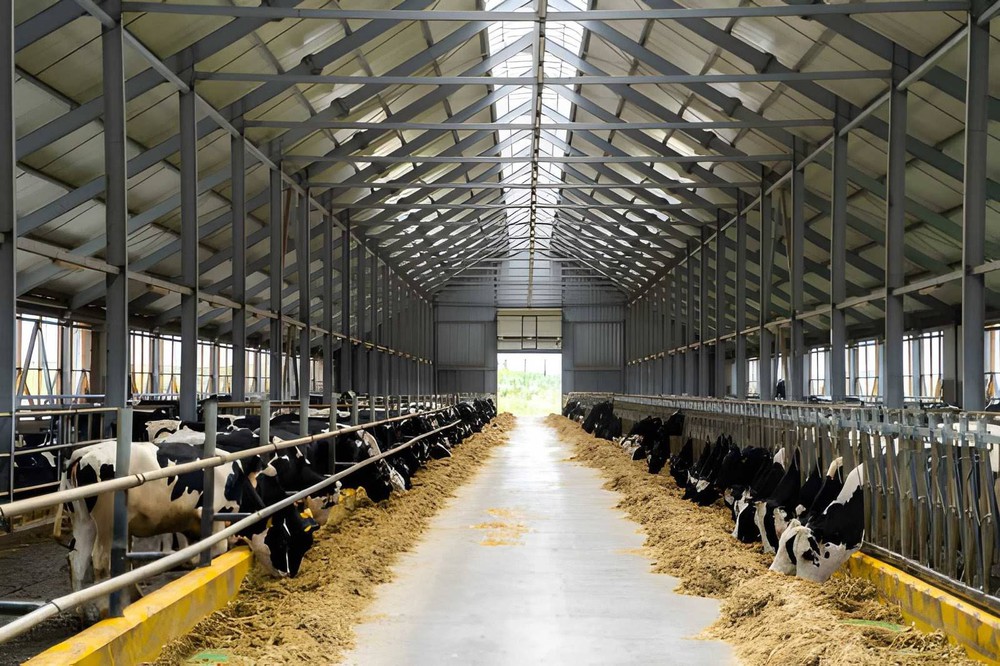
The barn shell - the post-frame or steel structure, roofing, concrete pads, and stall hardware - is the foundation of your budget. According to University of Wisconsin Extension and Cornell Cooperative Extension cost benchmarks, a turnkey freestall barn structure (excluding electrical, plumbing, and the milking system) runs approximately $3,000 to $3,500 per stall in recent build data. Adjusted for material and labor cost increases since 2022, current 2025–2026 construction is trending at $3,000 to $4,500 per stall, or roughly $22 to $30 per square foot.
Electrical and plumbing are typically quoted separately and add $300–$600 per stall depending on the complexity of lighting, fans, waterers, and heated pipes in cold-climate builds.
POST-FRAME SHELL
$18–$24/ft²
materials + labor, basic natural ventilation
Most common choice for Midwest and Northern Plains
operations. Relies on open sidewalls and ridge ventilation.
STEEL FRAME SHELL
$24–$32/ft²
materials + labor, wider clear spans
Better suited for large-width barns (over 200 ft).
Eliminates interior columns that restrict cow movement.
STALL HARDWARE (PER STALL)
$180–$350
loop dividers, neck rail, brisket board
Galvanized steel dividers installed on concrete curbs.
Cost rises with wider stall widths for larger breeds.
CONCRETE ALLEYS
$8–$14/ft²
4–5" reinforced slab with grooved finish
Grooved concrete reduces lameness by 30–40% vs. smooth.
Rubber alley flooring is a premium option at $12–$18/ft².
Whole-Project Cost: The Full Budget Breakdown
The barn shell is only part of the picture. A complete dairy operation requires feed storage, a milking center, manure storage, and site preparation. University of Wisconsin Extension estimates a total capital investment of $8,000–$10,000 per cow for a new dairy complex on a greenfield site, encompassing all infrastructure. With post-2022 cost escalation, current projects are more typically landing between $9,000 and $14,000 per cow for full builds.
| BUDGET LINE ITEM | COST PER COW (LOW) | COST PER COW (HIGH) | NOTES |
|---|---|---|---|
| Freestall Barn Housing | $3,000 | $5,000 | Structure, alleys, stall hardware |
| Milking Center (parlor-based) | $1,500 | $3,500 | Amortized per cow for a double-16 parlor |
| Robotic Milking (AMS) | $3,500 | $6,000 | If substituting parlor; $200K–$300K per robot unit |
| Manure Storage & Handling | $700 | $1,500 | Lagoon, reception pit, scrapers/flush system |
| Feed Storage (silos, bunkers) | $500 | $900 | Bunker silos are lowest cost option |
| Site Preparation & Earthwork | $400 | $1,000 | Grading, lanes, utilities hookup |
| Calf Housing (if on-site) | $200 | $600 | Hutches vs. group calf barn |
| Total (parlor milking) | $6,300/cow | $12,500/cow | Greenfield new build |
Example: A 500-cow dairy built from scratch with a double-24 parallel parlor, deep-sand freestall barn, lagoon manure storage, and bunker silos is realistically budgeted at $4.5M–$6.5M total in the upper Midwest in 2026 - or roughly $9,000–$13,000 per cow.

Cost by Herd Size
Economies of scale are significant in dairy construction. Larger operations have lower per-cow infrastructure costs because fixed-cost items like the milking parlor, bulk tank, and lagoon structures are spread across more animals.
| HERD SIZE | BARN STRUCTURE COST | ALL-IN ESTIMATE | COST EFFICIENCY |
|---|---|---|---|
| 100 cows | $350,000–$500,000 | $1.2M–$1.8M | Low |
| 250 cows | $800,000–$1.2M | $2.8M–$4.0M | Moderate |
| 500 cows | $1.5M–$2.2M | $4.5M–$6.5M | Good |
| 1,000 cows | $3.0M–$4.0M | $8M–$12M | Best |
| 2,500 cows | $6.5M–$9.0M | $20M–$30M | Best |
The 5 Biggest Cost Drivers
1. Ventilation System Type
A naturally ventilated barn with open sidewalls and curtains is the lowest-cost ventilation option and the standard in most of the U.S. Midwest and Northeast. A mechanically ventilated (tunnel vent) barn requires large fans, enclosed sidewalls, and in hot climates, evaporative cooling pads, adding $300–$700 per stall to the structure cost but significantly improving cow comfort in southern and western states.
2. Bedding System
The choice of bedding affects both capital and operating costs. Sand is the lowest capital-cost bedding option for stall surfaces, but requires a sand-manure separation system that adds $150,000–$400,000 to the manure handling budget on mid-size dairies. Rubber mattresses cost $50–$100 per stall installed, with a useful life of 4–7 years. Waterbed stalls run $250–$400 per stall installed and last 10–15 years. Recycled manure solids (RMS) as bedding require a mechanical separator ($80,000–$200,000) but eliminate ongoing bedding purchase costs.
3. Manure Handling Infrastructure
Manure handling represents $700–$1,500 per cow of total project cost and is often the most variable budget line. Flushed systems require a large lagoon and pump infrastructure. Scraped systems need automatic alley scrapers ($15,000–$35,000 per alley). Anaerobic digesters can offset operating costs through biogas generation but add $1M–$3M+ in capital cost, typically viable only for herds of 1,000+ cows.
4. Geographic Location and Labor Market
Construction costs vary substantially by region. The upper Midwest (Wisconsin, Minnesota, Iowa) tends to be the most cost-competitive market for dairy barn construction due to the density of experienced agricultural contractors. The Southeast, Pacific Northwest, and Northeast typically run 15–25% higher on labor. Permit and regulatory costs also vary: some jurisdictions require an engineered nutrient management plan and environmental impact assessment before permits are issued.
5. Milking System Choice
The milking center is often the single most expensive component of a new dairy. A double-16 or double-24 parallel parlor with structure and equipment runs $600,000–$1.2M. A rotary parlor can reach $1.5M–$3M. Each robotic milking unit (AMS) costs $200,000–$300,000 per robot, with each unit typically handling 55–70 cows, making robot-based systems competitive on a per-cow basis for herds under 300 cows and offering significant labor savings.
Return on Investment
Despite the high upfront cost, research consistently shows that well-designed freestall barns deliver strong returns. University of Wisconsin Extension data indicates a freestall barn with a 20-year useful life can pay for itself in 7 to 10 years through improved labor efficiency, higher milk production, and reduced health costs.
7–10
YEARS TO PAYBACK (TYPICAL)
20–25
YEAR USEFUL LIFE OF STRUCTURE
30–50%
FEWER LABOR HOURS PER CWT MILK
The primary financial levers are labor productivity (more cows milked per worker), lower somatic cell count penalties (lower SCC improves milk check), and reduced culling rates from improved cow comfort. Each additional pound of milk produced per cow per day, multiplied across the herd, compounds the return on capital quickly in strong milk markets.
Practical Ways to Reduce Construction Costs
Phase the build. Construct the freestall barn first, then add infrastructure in subsequent years. This spreads debt service and lets the operation generate cash before building out the full complex.
Use a naturally ventilated design. In climates where summer temperatures stay below 80°F for most of the day, natural ventilation adds minimal heat stress risk and avoids $300–$600/stall in fan and mechanical costs.
Source concrete work competitively. Concrete is consistently the largest single labor cost. Getting three to five bids from contractors with dairy-specific experience can move the needle by 10–20%.
Choose bunker silos over upright silos. Horizontal concrete bunkers cost $30–$60 per ton of storage capacity. Upright silos run $80–$150 per ton. For high-throughput TMR operations, bunkers offer comparable feed quality at lower capital cost.
Reuse existing infrastructure. If converting from a tie-stall or stanchion operation, the existing well, road access, power service, and in some cases the building pad can reduce greenfield site costs by $200,000–$500,000.
Plan for expansion from day one. Adding a second barn row to an existing facility after construction is expensive - typically 25–40% more per stall than building it originally. Site the first barn with a matching second barn footprint already cleared and graded.
Pro tip: Engage an agricultural engineer from your state's land-grant university extension service early in the process. Many offer low-cost or free preliminary design consultations, and their cost estimates are typically more conservative and regionally accurate than national averages.
FAQ
01.How much does a freestall barn cost per cow?
The building structure alone runs approximately $3,000–$4,500 per stall in 2026. When you add manure handling, feed storage, site prep, and a milking center, total capital cost typically ranges from $9,000 to $14,000 per cow for a full new dairy complex.
02.What is the most expensive part of building a freestall barn?
Concrete work (alleys, pads, manure storage) and the milking parlor or robotic milking system consistently represent the largest line items in dairy construction budgets, often exceeding the barn structure itself.
03.How long does a freestall barn last?
A well-built freestall barn has an expected useful life of 20–30 years for the structure. University extension research notes that a properly managed freestall barn can pay for itself in 7 to 10 years through improved labor efficiency and cow performance.
04.Is a robotic milking system more expensive than a parlor?
Per unit, robotic milking systems (AMS) cost $200,000–$300,000 each, with each unit handling 55–70 cows. For small herds under 200–300 cows, AMS can be cost-competitive with a parlor build when you account for labor savings. For herds above 500 cows, a conventional parallel or rotary parlor typically offers a lower capital cost per milking stall.
05.Can I build a freestall barn in phases?
Yes. Phased construction is common in dairy. A typical sequence: (1) build the freestall barn shell, (2) add milking infrastructure, (3) expand feed and manure storage. Planning for future expansion in the original site layout avoids costly retrofits.
06.Does the cost differ significantly between states?
Yes, meaningfully. Wisconsin, Minnesota, and Iowa tend to have the most competitive dairy construction markets and the widest pool of experienced contractors. Coastal states and the Southeast can run 15–25% higher on comparable builds. Permitting costs also vary: some states require full environmental impact assessments for confined animal feeding operations above certain animal unit thresholds.