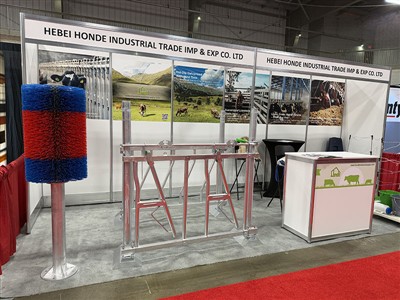
A cattle massage brush is a mechanical grooming device designed to help cattle scratch, rub, and groom their bodies while housed on a dairy or livestock farm. Unlike ordinary fixed brushes, an automatic cattle massage brush can rotate or move when the animal applies pressure, allowing cows to groom areas that are difficult to reach with the tongue, horns, tail, or hooves.
As modern dairy farms increasingly focus on animal welfare, cow comfort, hygiene, and efficient herd management, grooming equipment has become an increasingly useful part of loose-housing systems. A well-designed cattle massage brush does more than simply clean the animal's coat. It gives cattle an opportunity to express a natural comfort behavior and may provide farmers with useful information about animal activity and welfare.
Research supports the behavioral value of this type of enrichment. A study of 72 dairy cows found that installing a mechanical brush increased total scratching time by 508% and scratching frequency by 226%. Within seven days, 93% of the cows had used the brush.
At the same time, farmers should view a cattle massage brush as part of a complete cattle housing system rather than as a stand-alone solution for productivity. Brush design, location, accessibility, herd size, hygiene, and routine maintenance all affect how effectively the equipment is used.
What Is a Cattle Massage Brush and How Does It Work?
A cattle massage brush, also called an automatic cow brush, cow grooming brush, rotating cow brush, or dairy cow brush, is installed in an area where cattle can approach it freely.
When a cow pushes or rubs against the brush, the mechanical system may activate the rotating brush. Depending on the design, the brush may rotate around a fixed axis or swing in different directions as the cow changes position.
This design is important because cattle do not groom every part of their bodies in the same way. They can use their tongues, tails, horns, and hooves for self-grooming, but some areas are difficult to reach. Under indoor housing conditions, cattle may instead rub against gates, walls, water troughs, and other structures.
The European Food Safety Authority (EFSA) identifies self-grooming as an important comfort behavior for dairy cattle and notes that cow brushes can facilitate self-grooming, particularly in indoor housing systems. EFSA also points out that appropriate space and non-slip flooring are important because cattle may adopt unusual postures while grooming.
A mechanical brush therefore provides a dedicated surface for grooming instead of requiring cows to find unsuitable objects around the barn.
Why Do Dairy Cows Use Massage Brushes?
The primary reason cattle use a massage brush is simple: grooming is a natural behavior.
Cattle naturally seek abrasive surfaces to scratch their bodies. On pasture, trees, posts, bushes, and other objects can provide these opportunities. In a freestall barn, however, those natural structures may not be available.
A dedicated cattle massage brush gives cows a controlled way to perform this behavior.
Research has demonstrated strong motivation for access to grooming equipment. In a study of dairy cattle, cows significantly increased their scratching behavior after a mechanical brush was installed. The brush accounted for 91.1% of total scratching time and 79.8% of scratching events during the experimental period.
The significance is not simply that cows enjoy rubbing against a brush. Grooming helps animals maintain their body surface and provides tactile stimulation. Mississippi State University Extension describes cow brushing as a form of environmental enrichment, allowing cattle to express natural grooming behavior while potentially supporting physical and psychological well-being.
This makes the cattle massage brush particularly relevant to modern loose-housing systems, where farmers need to balance efficient production with opportunities for natural animal behavior.
What Are the Main Benefits of a Cattle Massage Brush?
The benefits of a cattle massage brush can be divided into several areas: grooming behavior, cleanliness, animal comfort, environmental enrichment, and farm management.
Supports Natural Grooming
The most direct benefit is that cows have easier access to a suitable grooming surface.
In the previously mentioned 72-cow study, total scratching time increased by 508% after the mechanical brush was introduced. This indicates that the brush did not simply replace existing scratching behavior; it substantially increased the amount of grooming that cows performed.
Helps Keep Cattle Cleaner
Regular rubbing can help remove loose hair, dirt, and debris from the animal's body.
A 2010 study involving 30 first-lactation dairy cows found that cows provided with an automatic brush were cleaner and scratched more frequently than cows in the control group. However, the researchers did not find a significant difference in milk yield between the two groups.
This is an important distinction for farmers: a cattle massage brush has clear behavioral and cleanliness benefits, while its effect on production can depend on farm conditions.
Provides Environmental Enrichment
Indoor cattle housing can limit opportunities for natural behaviors. A grooming brush gives cows an additional way to interact with their environment.
Mississippi State University Extension describes tactile enrichment as a way of modifying the environment to support physical, mental, and emotional well-being. Cow brushes are specifically identified as a practical form of tactile enrichment.
For modern dairy operations, this means a brush can complement other management practices such as comfortable freestalls, suitable flooring, clean water, adequate feeding space, and proper ventilation.
May Support Better Herd Monitoring
Brush use can also provide behavioral information.
Research has found that reduced grooming can be associated with changes in health or welfare. Recent research on automated brush monitoring has explored whether changes in brush use could help identify abnormal behavior or potential health problems.
Farmers should not use brush activity alone to diagnose disease, but unusual changes in an individual cow's normal behavior may be worth observing alongside feeding, rumination, locomotion, and other management indicators.
May Reduce Wear on Other Farm Structures
Cows looking for places to scratch may rub against gates, fences, water troughs, and other structures. Providing a dedicated grooming brush can redirect this behavior toward equipment designed for that purpose.
Mississippi State University Extension notes that dedicated cow brushes may help reduce unnecessary wear on structures that cattle otherwise use for scratching.
Does a Cattle Massage Brush Increase Milk Production?
This is one of the most important questions for farmers, but it requires a careful answer.
Some studies have reported positive effects on milk production, while others have found no significant difference. For example, the 2010 study of 30 first-lactation cows found improved cleanliness and scratching behavior but no significant difference in milk yield.
More recent research has reported different results. A 2024 study involving several groups of dairy cows found that mechanical brush use improved body-surface cleanliness and was associated with increased milk production among lactating cows, with particularly strong effects reported in cows of the fourth and fifth parities.
A 2026 review of recent research reached a more cautious conclusion: access to brushes consistently increases grooming behavior and is associated with welfare benefits, while evidence for production responses remains variable and may depend on animal characteristics, management conditions, brush accessibility, and study design.
Therefore, a cattle massage brush should not be marketed or evaluated simply as a "milk production machine."
Its strongest and most consistent value is supporting natural grooming behavior and animal comfort. Any production benefit should be considered a possible secondary effect rather than a guaranteed result.
Where Should a Cattle Massage Brush Be Installed?
Brush location can significantly influence how often cattle use it.
A brush should be placed where cows naturally spend time and where they can approach, turn, and leave without creating unnecessary congestion.
Suitable areas may include locations near:
●Feeding areas
●Water points
●Cow traffic lanes
●Resting-area exits
●Other frequently visited parts of the barn
However, the brush should not block normal cow movement or create competition that prevents subordinate animals from accessing it.
Research examining brush placement and group size found that cows used an automated brush for longer when it was positioned near the feed bunk and water area compared with a back alley. The study also found that brush use increased as group size decreased, although the brush was never in use for more than 50% of the day regardless of group size.
This suggests that placement is not simply a construction decision; it is a herd-management decision.
Farmers should consider traffic flow, available space, cow size, social competition, flooring conditions, and ease of access before installation.
The brush should also be positioned so that cows can use it without slipping or being forced into awkward positions. EFSA specifically identifies sufficient space and non-slip flooring as important for normal self-grooming behavior.
How Should Farmers Choose and Maintain a Cattle Massage Brush?
The right cattle massage brush should be selected according to the animals, housing system, and intended application rather than based only on appearance or price.
A practical evaluation should consider the brush's construction, bristle material, frame strength, activation mechanism, rotation or swinging design, mounting method, and ease of cleaning.
For dairy farms, durability is particularly important because the equipment may be exposed to moisture, manure, dust, hair, and continuous animal contact.
The brush should also provide a grooming surface that is firm enough to be useful but designed with appropriate materials and movement to avoid unnecessary injury.
Maintenance is equally important. Farmers should regularly inspect:
●Brush wear and bristle condition
●Rotating or moving components
●Mounting brackets and fasteners
●Electrical components on motorized models
●Accumulated dirt, manure, and hair
●Unusual noise or changes in movement
Cleaning should be incorporated into normal barn maintenance. A dirty grooming brush can reduce its usefulness and may become a hygiene concern rather than an enrichment tool.
The Kentucky Cooperative Extension also notes practical limitations: motorized brushes require electrical infrastructure and higher initial investment, while overcrowding a brush can allow dominant cows to use it more than subordinate animals. Its guidance gives 60 cows per brush as a recommended stocking level in the context discussed in its publication, while emphasizing that brush investment should not automatically be justified by expected production gains alone.
This is a useful reminder that brush quantity should be evaluated together with herd size and access rather than simply choosing one brush for an entire large herd.
A cattle massage brush can be one useful addition to a dairy farm, but cow comfort also depends on appropriate housing, resting space, and access to water and feed. See our complete guide to [Cattle Farm Equipment] for an overview of equipment that supports different aspects of dairy farm management.